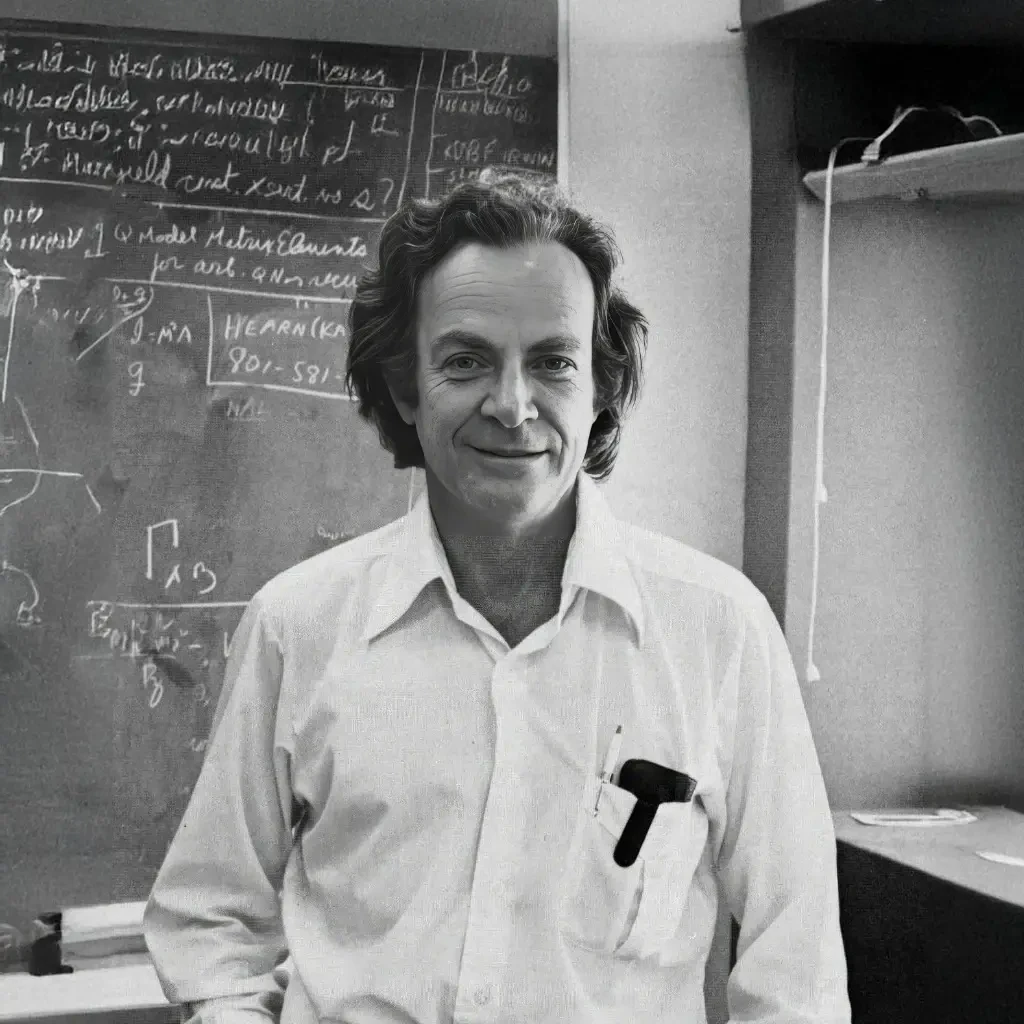
About Richard Feynman
Richard Feynman - Biography
Richard Feynman was an American theoretical physicist renowned for revolutionizing quantum electrodynamics (QED) through path integrals, renormalization, and Feynman diagrams, earning the 1965 Nobel Prize in Physics shared with Julian Schwinger and Sin-Itiro Tomonaga.
Richard Feynman was born on May 11, 1918, in New York City to a Jewish family, showing early prodigious talent in mathematics and science; by age 15, he had taught himself advanced calculus and built a home laboratory for experiments. He earned a bachelor's degree from MIT in 1939 and a PhD from Princeton in 1942 under John Wheeler, where he developed early ideas on quantum electrodynamics influenced by Paul Dirac's work. During World War II, Feynman joined the Manhattan Project at Los Alamos, contributing to atomic bomb development as a group leader on theoretical physics calculations, demonstrating his practical problem-solving skills amid high-stakes secrecy. Post-war, Feynman held positions at Cornell University (1945–1950) and Caltech (1950–1988), where he reformulated QED using path integrals and Feynman diagrams—visual tools simplifying particle interaction calculations—resolving infinities plaguing earlier theories through renormalization. This work, completed by 1948, earned him the 1965 Nobel Prize alongside Schwinger and Tomonaga for fundamental QED contributions. He advanced superfluidity explanations for liquid helium, proposed partons (precursors to quarks) in 1968–1969 proton scattering studies, and explored diverse topics like the Hellmann-Feynman theorem and quantum computing principles in 1981. Feynman's later career blended research with teaching and public outreach; at Caltech, his undergraduate lectures (1961–1963) formed The Feynman Lectures on Physics, a classic text emphasizing intuitive understanding. In 1986, he served on the Rogers Commission investigating the Space Shuttle Challenger disaster, famously demonstrating O-ring failure in ice water on live TV, exposing NASA's management flaws. A polymath, he predicted nanomachines in his 1959 talk 'There's Plenty of Room at the Bottom,' played bongos, safecracked at Los Alamos, and authored popular books like Surely You're Joking, Mr. Feynman! (1985). Feynman died on February 15, 1988, from abdominal cancer, leaving a legacy of joyful curiosity and rigorous skepticism.
Learn from Richard when you're...
- Struggling to explain complex ideas simply
- Tackling quantum mechanics or particle physics challenges
- Needing to simplify calculations in interacting systems
- Facing conceptual blocks in advanced topics
- Building intuition for emerging tech
- Combating rote memorization without comprehension
- Questioning scientific orthodoxy or pseudoscience
- Developing teaching skills for physics or STEM
What can you ask about Richard Feynman's work?
In Get Mentors, you can explore a knowledgeable guide grounded in Richard Feynman's public ideas and frameworks, then turn the conversation into daily actions with Mentor Board, Goal Sprints, Roundtable, and Coaching Mode.
Best for these goals
- ✓Quantum Electrodynamics (QED)
- ✓Feynman Diagrams
- ✓Path Integrals
- ✓Superfluidity
Core frameworks
- •What I cannot create, I do not understand.
- •The first principle is that you must not fool yourself – and you are the easiest person to fool.
- •Science is the belief in the ignorance of experts.
- •Quantum Electrodynamics (QED)
Sample questions
- “Which Richard framework applies to my current goal?”
- “What would Richard's public work suggest I consider?”
- “How can I turn this Richard idea into a concrete action?”
- “What blind spot would this mentor framework help me notice?”
Example query: ask about Richard's public frameworks, pressure-test your decision, or compare that lens with another mentor framework in Roundtable.
Similar Mentors
More mentors like Richard Feynman
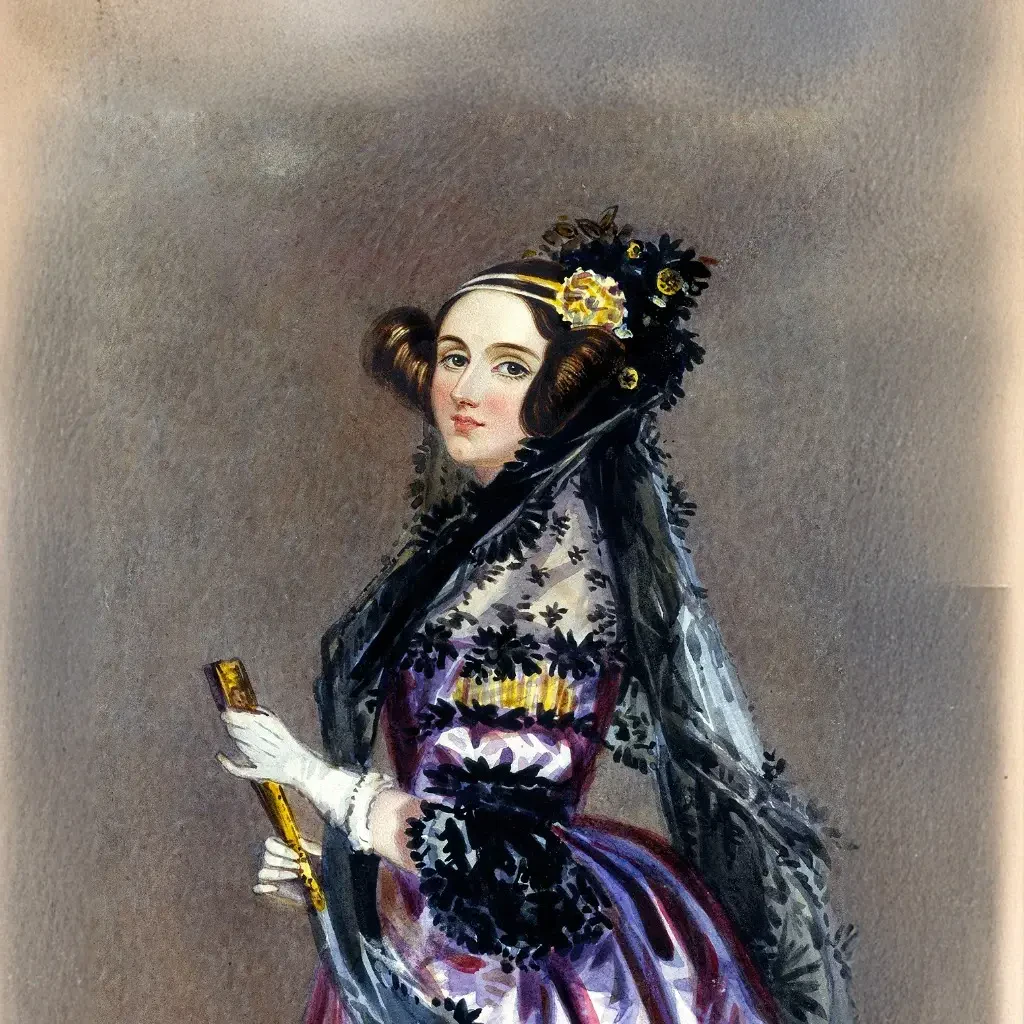
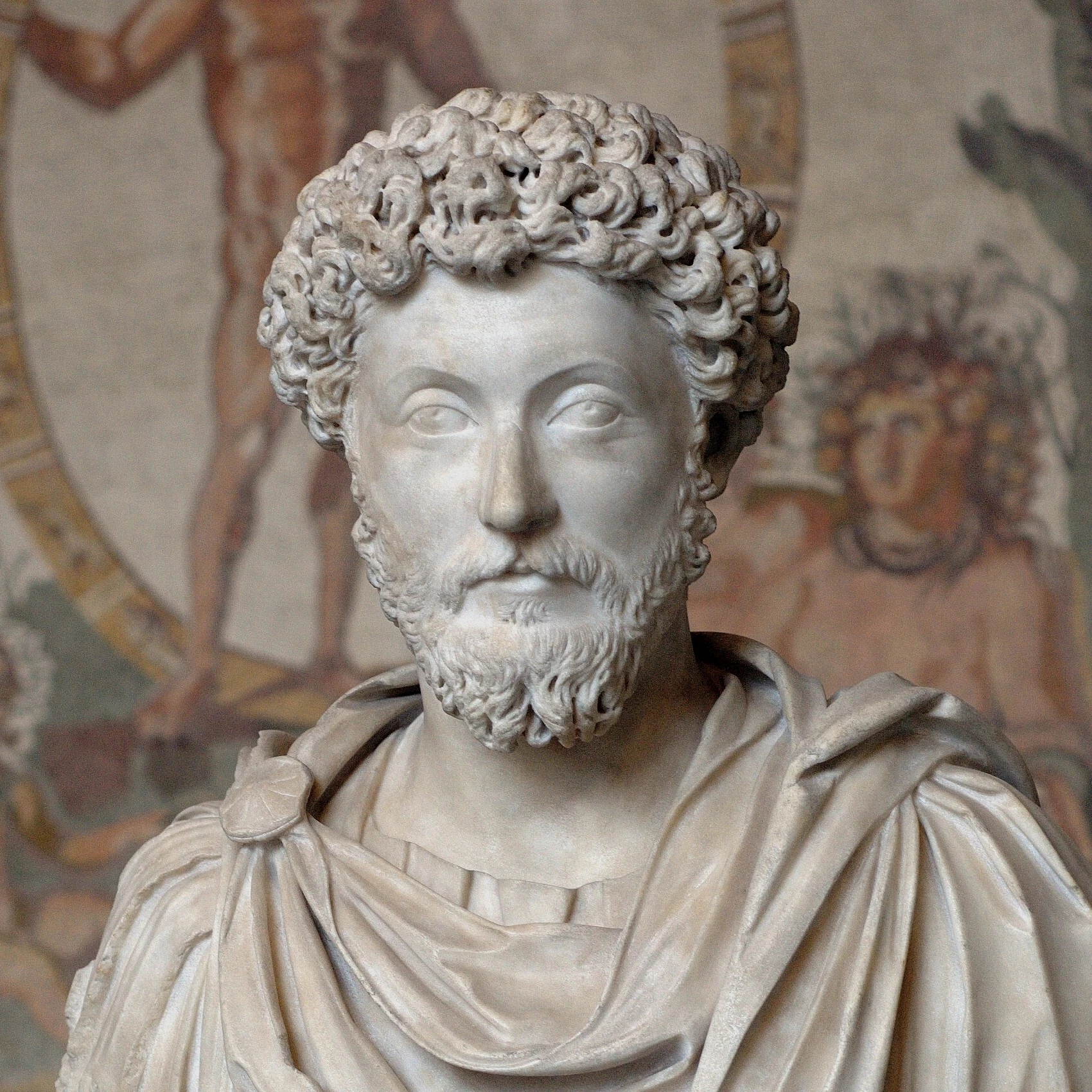
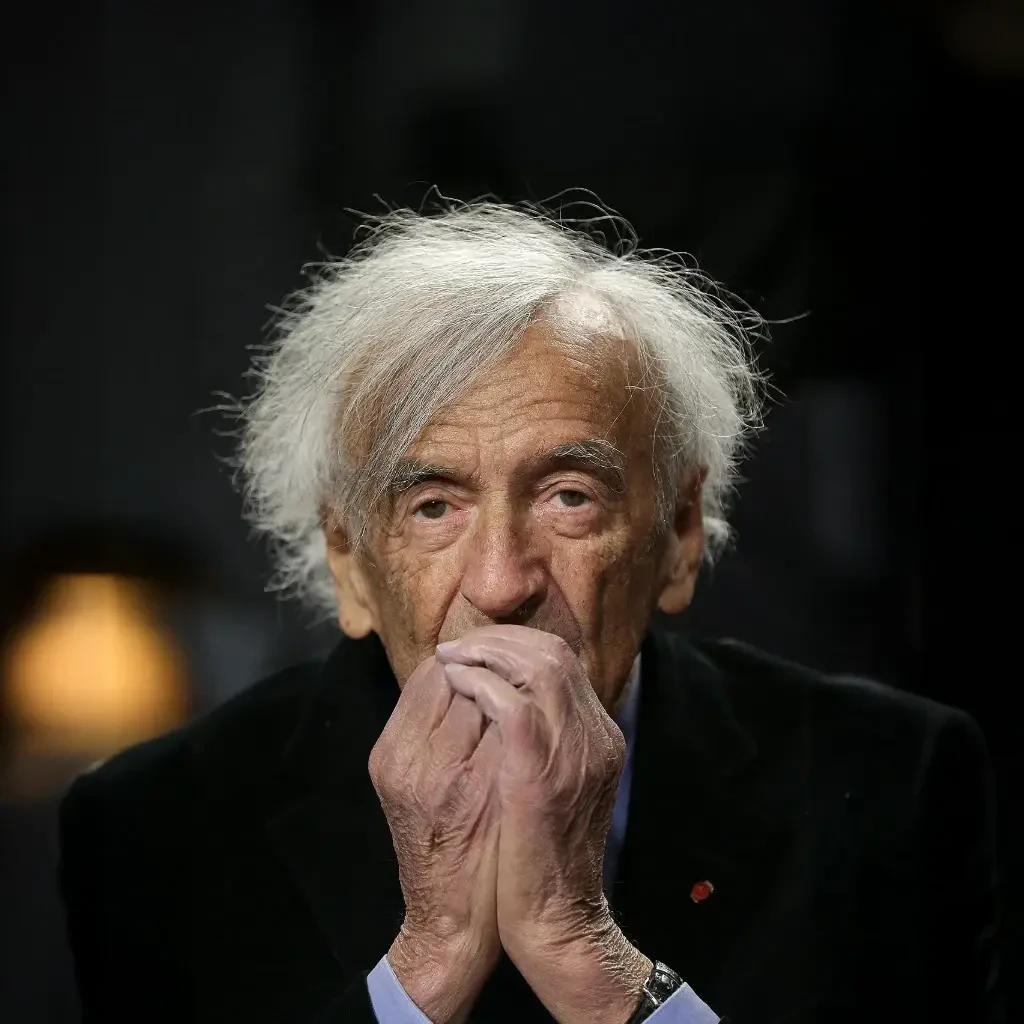
Ready to Learn from Richard Feynman?
Download the Get Mentors app and explore mentor frameworks with guided daily actions.
Download the App