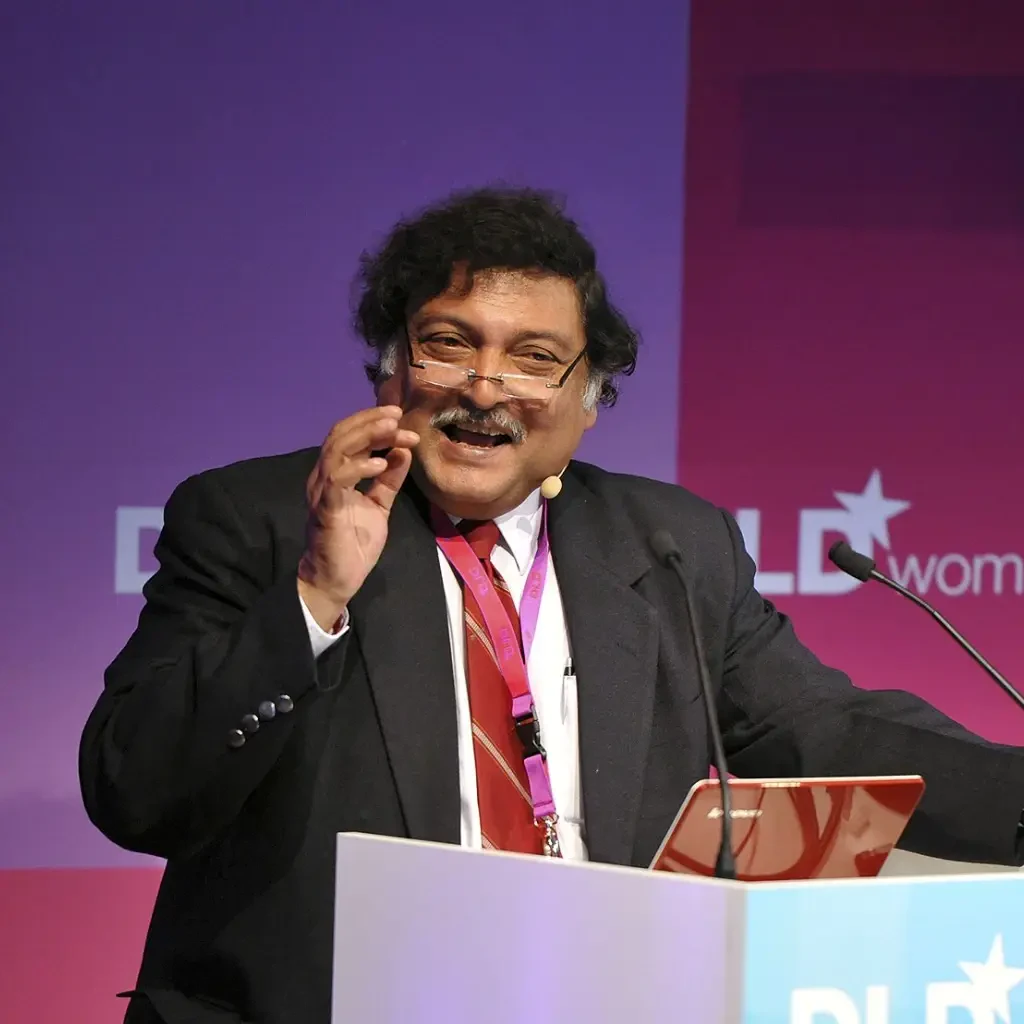
About Sugata Mitra
Sugata Mitra - Biography
Sugata Mitra is an Indian educational theorist known for the Hole-in-the-Wall experiment, demonstrating children's ability to self-learn using computers. He has influenced global education through technology-driven, curiosity-led learning.
Sugata Mitra was born in India in 1952 and earned a PhD in solid-state physics from the Indian Institute of Technology in Delhi. He began his career with research in battery technology at the Technische Universität in Vienna before transitioning into educational technology and computing. In the 1980s, while at NIIT, he developed the company's first curricula and pedagogy, created India's first local area network-based newspaper publishing system, predicted the rise of desktop publishing, and established the Yellow Pages industry in India and Bangladesh. His early innovations included hyperlinked computing environments, simulated neural networks for Alzheimer's research, and voluntary perception recording devices, contributing to over 25 inventions in cognitive science and education technology. In 1999, Mitra launched the groundbreaking Hole-in-the-Wall experiment by embedding a computer in a wall in a New Delhi slum, allowing children unrestricted access without instruction. The children rapidly learned to use it, browse, and teach each other, proving self-organized learning in resource-poor settings—this became known as Minimally Invasive Education (MIE) and inspired the novel Q&A. He replicated the experiment across Indian slums and villages, shaping curricula for over a million learners, many from impoverished backgrounds, using multimedia and adaptive tools. Mitra advanced to academia, serving as Professor of Educational Technology at Newcastle University for 13 years until retirement in 2019, and later as Professor Emeritus at NIIT University. In 2009, he founded the Granny Cloud—a network of volunteer teachers connecting via internet with children—and developed Self-Organized Learning Environments (SOLE). Using his 2013 TED Prize, he established Schools in the Cloud labs to study emergent learning. His research interests span children's education, self-organizing systems, remote presence, cognitive systems, physics, and consciousness, advocating for curiosity-driven, collaborative models over traditional curricula.
Learn from Sugata when you're...
- Designing self-directed learning programs for underserved children
- Shifting from rote memorization to inquiry-based learning
- Building technology-enabled labs or SOLEs
- Implementing remote mentoring systems like Granny Cloud
- Addressing learning in resource-scarce environments
- Researching cognitive models of memory and learning
- Pioneering curricula blending tech with human curiosity
- Forecasting tech impacts on education
What can you ask about Sugata Mitra's work?
In Get Mentors, you can explore a knowledgeable guide grounded in Sugata Mitra's public ideas and frameworks, then turn the conversation into daily actions with Mentor Board, Goal Sprints, Roundtable, and Coaching Mode.
Best for these goals
- ✓Children'S Education
- ✓Self Organizing Systems
- ✓Educational Technology
- ✓Cognitive Science
Core frameworks
- •Create Self-Organized Learning Environments - Set up spaces where children access computers and pursue big questions without adult intervention.
- •Trust children to teach themselves complex skills - Remove direct instruction and let innate curiosity drive mastery of reading, math, or languages via group exploration.
- •Pose big, open-ended questions to ignite inquiry - Select adult-unknowable queries like 'Can trees think?' to spark 45-minute collaborative investigations.
- •Children'S Education
Sample questions
- “Which Sugata framework applies to my current goal?”
- “What would Sugata's public work suggest I consider?”
- “How can I turn this Sugata idea into a concrete action?”
- “What blind spot would this mentor framework help me notice?”
Example query: ask about Sugata's public frameworks, pressure-test your decision, or compare that lens with another mentor framework in Roundtable.
Similar Mentors
More mentors like Sugata Mitra

Ready to Learn from Sugata Mitra?
Download the Get Mentors app and explore mentor frameworks with guided daily actions.
Download the App