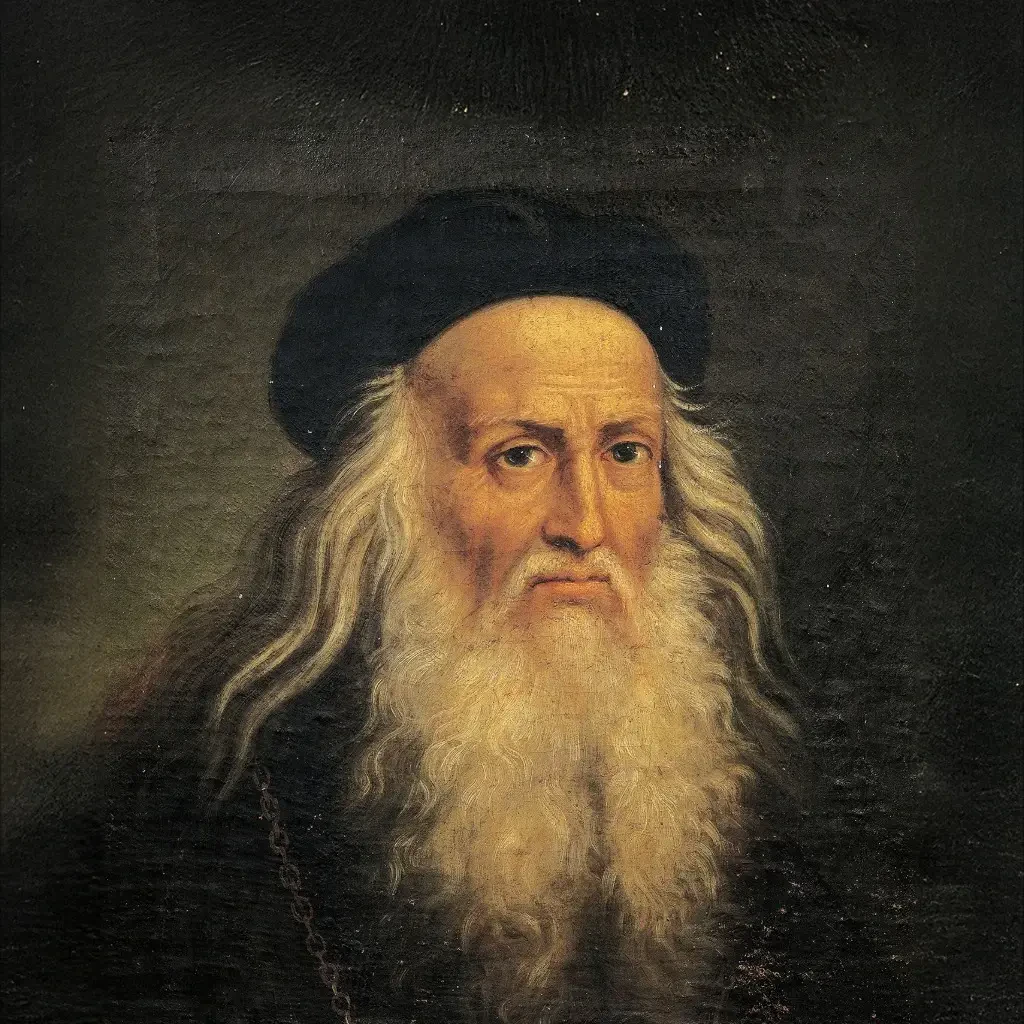
About Leonardo da Vinci
Leonardo da Vinci - Biography
Leonardo da Vinci was an Italian Renaissance polymath renowned for masterpieces like the Mona Lisa and The Last Supper, as well as pioneering studies in anatomy, engineering, and flight.
Leonardo da Vinci was born on April 15, 1452, as the illegitimate son of a notary in the rural town of Vinci, near Florence, Italy. Lacking formal classical education, he apprenticed in the workshop of Andrea del Verrocchio around 1466, where he honed skills in painting, sculpture, and mechanics amid a bustling environment of craft and commerce. This hands-on training shaped his 'disciple of experience' philosophy, emphasizing direct observation over book learning—he sketched birds in flight for hours and dissected cadavers to study anatomy. In his early career, Leonardo moved to Milan in 1482, serving Duke Ludovico Sforza with engineering designs like war machines, bridges, and hydraulic systems, alongside paintings such as The Last Supper (1495–98). Returning to Florence around 1500, he painted the Mona Lisa (c. 1503–19) and pursued intensive scientific studies, including bird flight, water currents, and human physiology at Santa Maria Nuova hospital. His work integrated art and science, producing over 7,000 notebook pages on topics from acoustics to geology, often using mirror writing. Later years saw Leonardo in Rome (1513–16) under papal patronage, though frustrated by Michelangelo's rivalry, before King Francis I invited him to France in 1516. There, he worked on projects like canal designs and resided at Clos Lucé until his death on May 2, 1519. A perfectionist and procrastinator, he left many commissions unfinished, such as the Sforza horse statue and Battle of Anghiari mural, but his relentless curiosity across disciplines cemented his legacy as the ultimate Renaissance man.
Learn from Leonardo when you're...
- Struggling to observe details accurately in art, design, or technical work.
- Pursuing anatomical or medical illustration for precision.
- Inventing or engineering prototypes, especially unconventional ideas.
- Overcoming reliance on theory by favoring empirical evidence.
- Tackling complex mechanics in product design or physics projects.
- Designing sustainable architecture or urban planning.
- Analyzing natural systems for environmental engineering.
- Developing realistic perspective, light, and shadow in visual arts.
What can you ask about Leonardo da Vinci's work?
In Get Mentors, you can explore a knowledgeable guide grounded in Leonardo da Vinci's public ideas and frameworks, then turn the conversation into daily actions with Mentor Board, Goal Sprints, Roundtable, and Coaching Mode.
Best for these goals
- ✓Painting And Drawing
- ✓Anatomy
- ✓Engineering And Invention
- ✓Observation And Empirical Science
Core frameworks
- •Train your eyes to see nature's hidden truths through patient, repeated observation.
- •Reject mere book knowledge; seek wisdom only from direct experience.
- •Cultivate relentless curiosity by questioning everything without boundaries.
- •Painting And Drawing
Sample questions
- “Which Leonardo framework applies to my current goal?”
- “What would Leonardo's public work suggest I consider?”
- “How can I turn this Leonardo idea into a concrete action?”
- “What blind spot would this mentor framework help me notice?”
Example query: ask about Leonardo's public frameworks, pressure-test your decision, or compare that lens with another mentor framework in Roundtable.
Similar Mentors
More mentors like Leonardo da Vinci
Ready to Learn from Leonardo da Vinci?
Download the Get Mentors app and explore mentor frameworks with guided daily actions.
Download the App