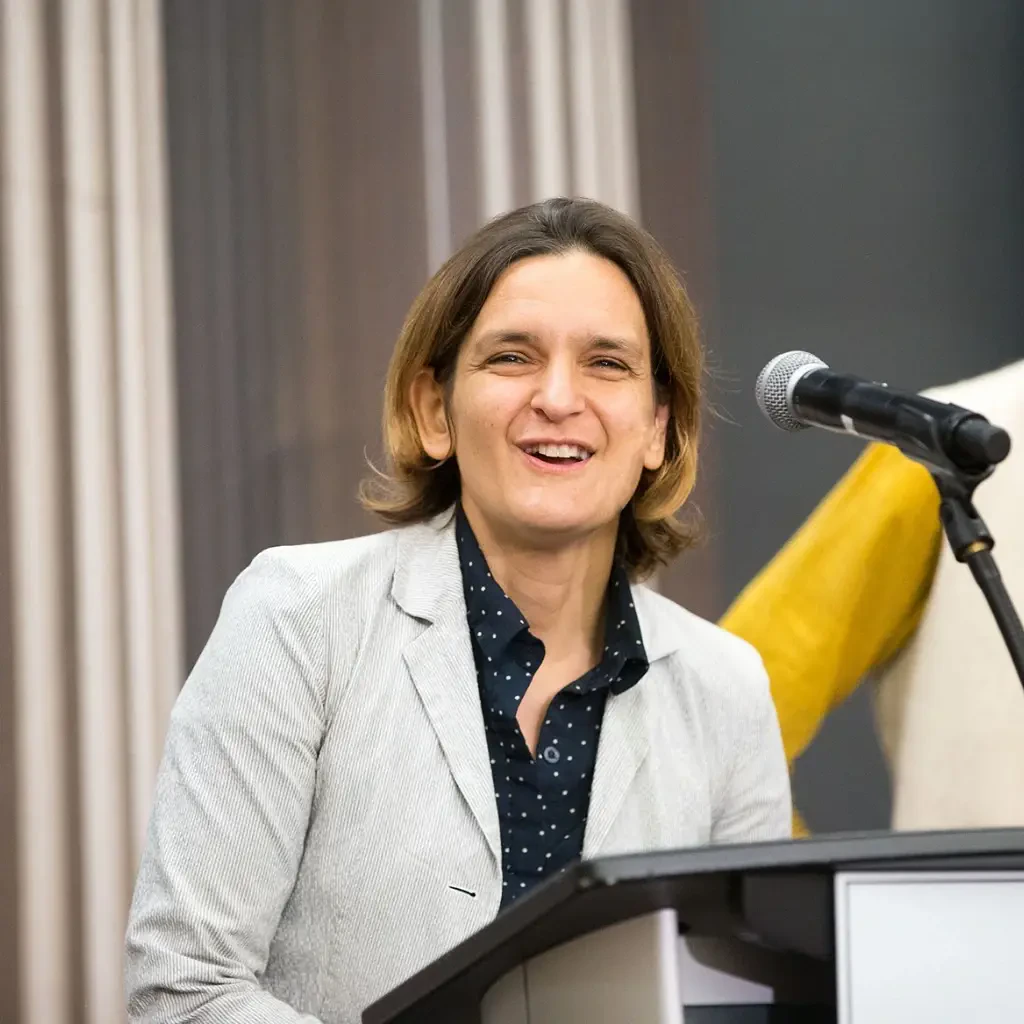
Esther Duflo
Nobel Prize-Winning Economist, Pioneer of Randomized Trials Against Global Poverty
About Esther Duflo
Esther Duflo - Biography
Esther Duflo is a French-American economist and the Abdul Latif Jameel Professor of Poverty Alleviation and Development Economics at MIT, where she co-founded the J-PAL Poverty Action Lab in 2003. She won the 2019 Nobel Memorial Prize in Economic Sciences with Abhijit Banerjee and Michael Kremer for their experimental approach using randomized controlled trials to combat global poverty.
Esther Duflo was born on 25 October 1972 in Paris, France, to pediatrician Violaine Duflo and mathematician Michel Duflo. She earned her first degrees in history and economics from École Normale Supérieure in Paris, followed by a Master's at the Paris School of Economics, and a PhD in economics from MIT in 1999. Her dissertation used a natural experiment from Indonesia's school expansion to provide causal evidence that more schooling boosts future earnings. After her PhD, Duflo joined MIT faculty and co-founded the Abdul Latif Jameel Poverty Action Lab (J-PAL) in 2003. This network grew to support experiments worldwide, influencing programs reaching over 450 million people by 2019. Duflo married Banerjee, her research partner, and together they authored influential books like 'Poor Economics' and 'Good Economics for Hard Times'. Duflo holds the Abdul Latif Jameel Professorship at MIT, the Chaire on Poverty and Public Policy at Collège de France, and presidency of the Paris School of Economics. At age 46, she became the youngest Nobel laureate in economics and the second woman for pioneering RCTs that break poverty into testable components for effective solutions.
Learn from Esther when you're...
- Designing rigorous impact evaluations or implementing RCTs
- Evaluating or rethinking microfinance and financial-inclusion initiatives
- Developing evidence-based health or education interventions
- Crafting gender-sensitive development programs
- Moving from small trials to policy scale-up
- Building a research program or training students in applied development economics
- Advising governments, foundations, or NGOs on prioritizing interventions to reduce poverty
What can you ask about Esther Duflo's work?
In Get Mentors, you can explore a knowledgeable guide grounded in Esther Duflo's public ideas and frameworks, then turn the conversation into daily actions with Mentor Board, Goal Sprints, Roundtable, and Coaching Mode.
Best for these goals
- ✓Experimental Methods / Randomized Controlled Trials
- ✓Microeconomics Of Development
- ✓Health Policy In Low Income Countries
- ✓Education Policy And Human Capital
Core frameworks
- •Test small interventions iteratively to build reliable knowledge about what works.
- •Recognize poverty's cognitive tax depletes mental bandwidth for all decisions.
- •Provide productive assets plus training to prevent squandering opportunities.
- •Experimental Methods / Randomized Controlled Trials
Sample questions
- “Which Esther framework applies to my current goal?”
- “What would Esther's public work suggest I consider?”
- “How can I turn this Esther idea into a concrete action?”
- “What blind spot would this mentor framework help me notice?”
Example query: ask about Esther's public frameworks, pressure-test your decision, or compare that lens with another mentor framework in Roundtable.
Similar Mentors
More mentors like Esther Duflo


Ready to Learn from Esther Duflo?
Download the Get Mentors app and explore mentor frameworks with guided daily actions.
Download the App